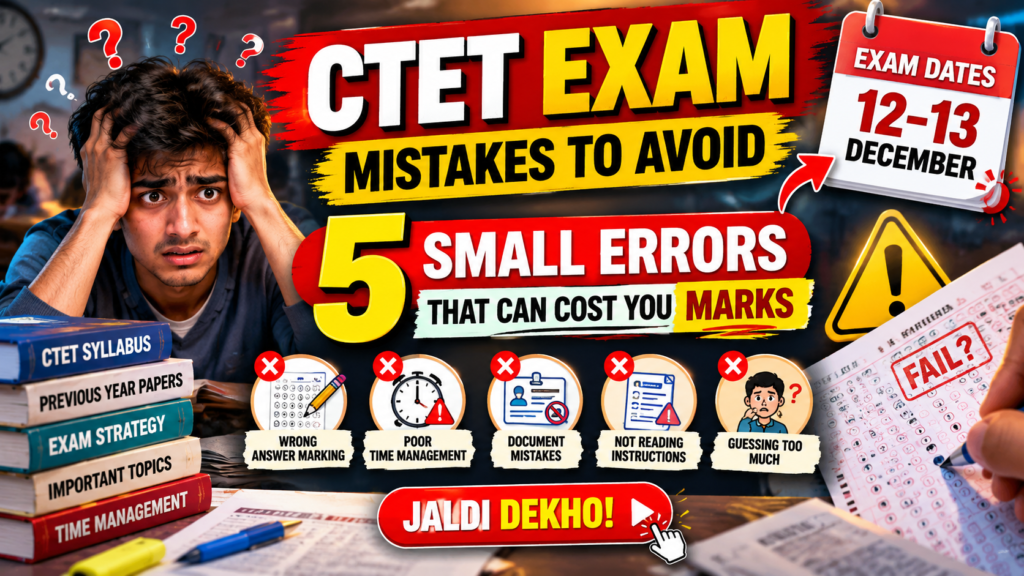
CTET Exam Mistakes to Avoid: 5 Small Errors That Can Cost You Marks on 12–13 December
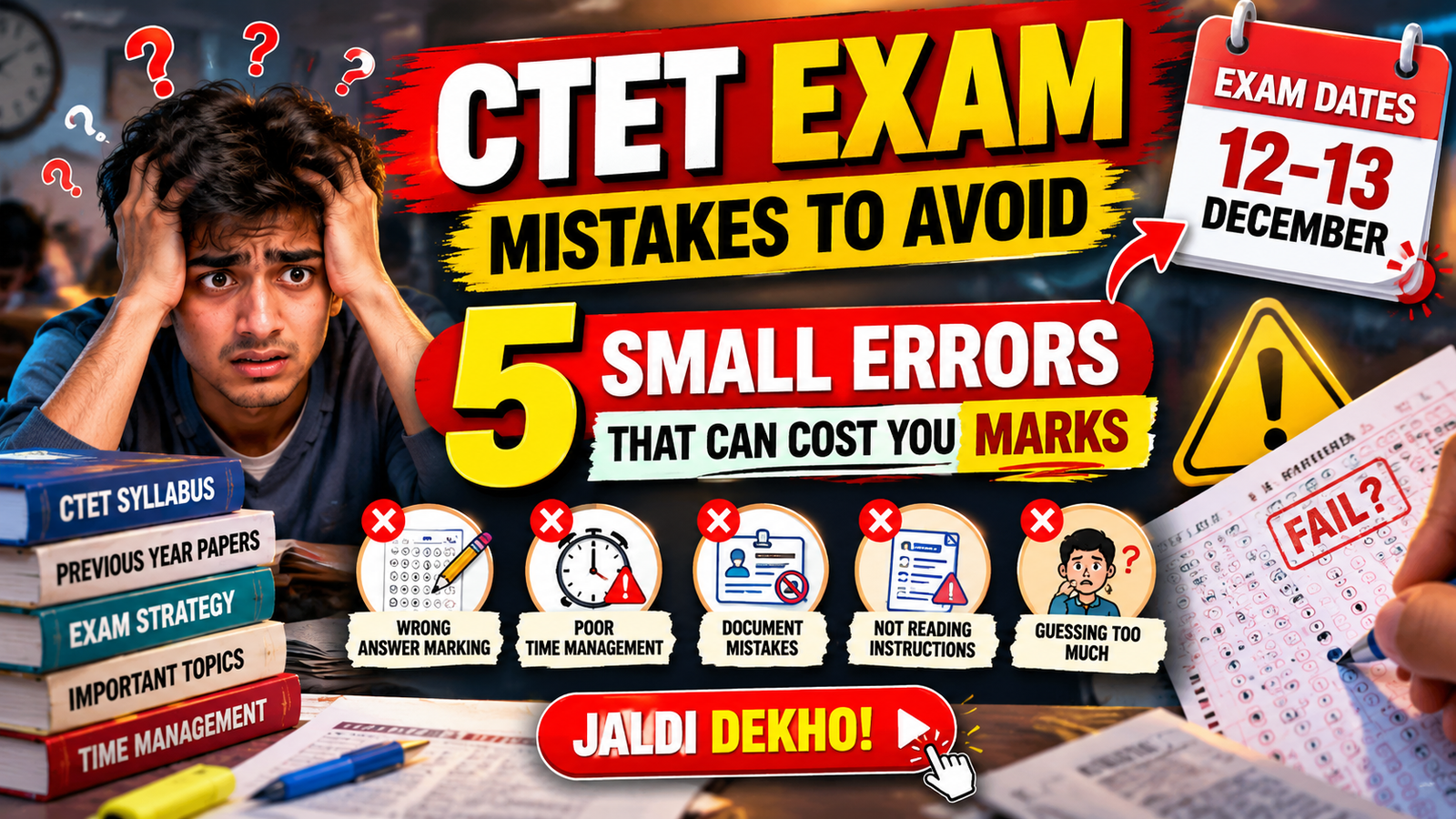
Many CTET candidates lose marks for reasons that have nothing to do with how well they prepared. A wrong pen, a mismatched booklet code, or a badly planned two and a half hours can hurt as much as a weak subject. With the exam set for 12 and 13 December 2026, you still have time to fix these.
Quick answer: The five biggest CTET exam mistakes are OMR sheet errors, a wrong or mismatched booklet code, poor time management, leaving questions blank, and ignoring exam-day instructions. One fact to remember: CTET has no negative marking.
| Mistake | What goes wrong | The fix |
|---|---|---|
| OMR errors | Wrong pen, faint or double marking, no way to change an answer | Blue or black ballpoint pen, one fully darkened circle |
| Booklet code mismatch | OMR code differs from the booklet | Match the code and report any mismatch at once |
| Poor time use | Stuck on hard questions, no time for the last part | About one minute per question, easy ones first |
| Blank answers | Marks lost for no reason | Attempt every question |
| Ignoring instructions | Late entry, banned items, unfair-means trouble | Read the admit card and bulletin rules |
Mistake 1: Making OMR Sheet Errors
The CTET paper is offline, and your answers count only if they are on the OMR sheet. The bulletin says to use a blue or black ballpoint pen and to darken the circle completely. It also said the pen would not be supplied this time, so bring your own good-quality pen.
Common OMR errors:
- Using a pencil or gel pen. Only a ballpoint pen is accepted.
- Half-filled circles, ticks or crosses. Darken one circle fully.
- Marking two circles. More than one circle for a question makes the answer invalid.
- Trying to change an answer. The test booklet states that no whitener is allowed for changing answers, and erasers are on the prohibited list.
- Writing rough work on the OMR. Do rough work only in the space given in the test booklet.
Tip: Mark each answer carefully the first time. You cannot fix it later.
Mistake 2: Wrong or Mismatched Booklet Code
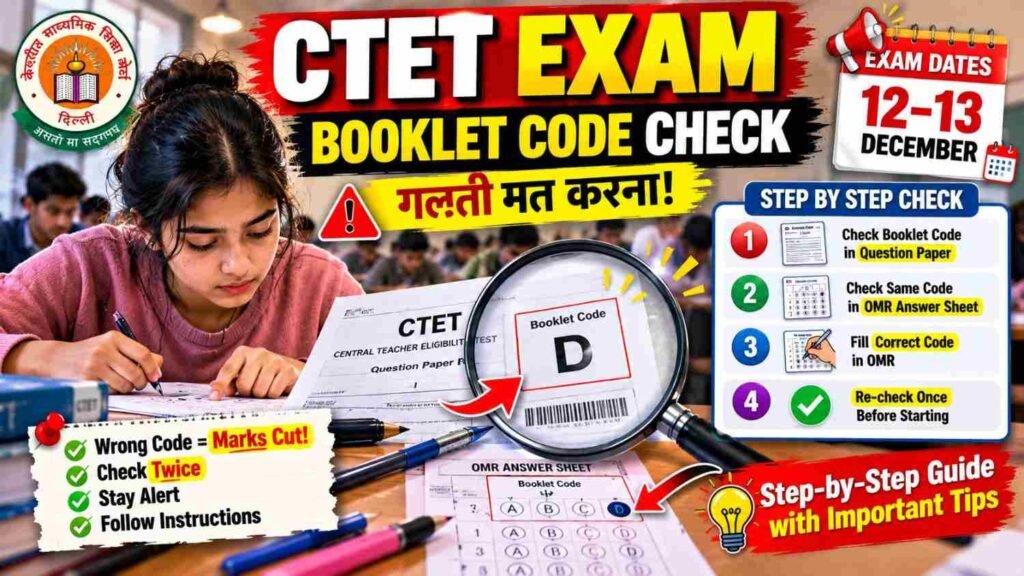
This is the mistake many first-timers never hear about. Side-2 of your OMR sheet has a pre-printed code (A, B, C or D). It must be the same as the code printed on your test booklet. You must also write the correct test booklet code or number as the bulletin directs.
If the two do not match, tell the invigilator immediately. The test booklet instructions say that in case of a discrepancy, both the booklet and the OMR sheet should be replaced. Also ensure that the test booklet number and the OMR sheet number are the same.
Some reports also warn that a wrong entry for the language supplement booklet code can lead to a withheld result. Check every code box twice before you start answering.
Mistake 3: Poor Time Management
The test has 150 questions in 2.5 hours, which works out to about one minute per question. A few simple habits help:
- Do the easy questions first and mark the tough ones to return to later.
- Do not spend more than a couple of minutes on one question.
- Fill the OMR as you go. Do not leave all the marking for the last 10 minutes.
- Keep 10 minutes at the end to check that every question has an answer and that no question has two circles.
Each paper has parts of 30 questions, so you can budget your time part by part. This is a strategy, not an official rule, so adjust it to your strength.
Mistake 4: Leaving Questions Blank
Some candidates leave questions blank because they fear losing marks. But the test booklet states clearly that the test has 150 questions and there is no negative marking. A wrong answer costs nothing, while a blank answer scores zero.
Make an informed guess where you can, for example by eliminating options you know are wrong. Never leave a question blank.
Mistake 5: Ignoring Instructions on the Admit Card and in the Bulletin
Small rule breaches cause big trouble:
- Reaching late. Entry stops when the gate closes, at 9:30 AM or 2:30 PM as per the bulletin’s original schedule. Confirm your own timing on your admit card.
- Carrying banned items. Wrist watches, phones, wallets, handbags and eraser are not allowed. Reports also list watches of any kind under prohibited items.
- Breaking the seal early. Do not open the test booklet until the invigilator tells you to.
- Not handing over the OMR sheet. As per the bulletin, a candidate who does not hand over the OMR sheet is deemed not to have handed it over and is dealt with as an unfair-means case.
- Forgetting your pen. Do not rely on the centre.
10-Minute Exam-Day Checklist
- Printed admit card and original photo ID
- Two blue or black ballpoint pens
- Check the booklet code against the OMR
- Write your details only in the given spaces
- Sign the attendance sheet as instructed
- Do not open the booklet until told to
CTET Mistakes: Common Student Questions
Can I change an answer on the OMR sheet?
No. Whitener is not allowed, and erasing is prohibited. Mark carefully the first time.
Is there negative marking in CTET?
No. The test booklet instructions state that there is no negative marking.
Will the centre give me a pen?
The bulletin says candidates must bring their own ballpoint pen (black or blue), and pens will not be supplied.
What if my booklet code and OMR code do not match?
Tell the invigilator immediately. Both the test booklet and the OMR sheet should be replaced.
Can I do rough work on the OMR sheet?
No. Do rough work only in the space provided in the test booklet.
Can I use a pencil or a gel pen?
No. Use only a blue or black ballpoint pen.
Final Words
Most of these mistakes cost nothing to avoid. Practise marking an OMR sheet with a ballpoint pen, learn the exam-day rules, and plan your time before 12 December. For the latest on city slip and admit card, read our guide on CTET Admit Card 2026. If you are also preparing for another TET, see our UPTET Result 2026 update.