abc
Direction for QI. to Q5. Read the following passage and answer the question that follows:
Your body is almost two-thirds water, so staying hydrated is important. Teenagers should aim to drink six to eight glasses of water per day, according to the British Nutrition Foundation. That number increases for teens who engage in sports or are especially active. Other good sources of fluid include 100 percent fruit juice and low-fat milk. Sugary and caffeinated drinks should be limited or eliminated from the diet completely as they provide excess sugar and empty calories.
According to the Cleveland Clinic, teenagers need at least nine hours of sleep each night to function at their best during the day. It sounds easy enough, but with early school start times, late afternoon practices and hours of homework, getting enough sleep can be a challenge. Set a regular bedtime that allows for nine hours of sleep before you have to get up for school. You should also plan for at least an hour of “quiet time” prior to bedtime. The goal is for all electronics to be turned off for the night so that the brain and body relax. Quiet time may involve listening to soothing music or reading a book
QI. Sports persons need to stay hydrated. They should drink enough:
(a). water and 100% fruitjuices
(b). water, milk, coffee
(c). water, juices, tea and coffee
(d). Sugary and caffeinated drinks as well as enough plain water
Q2. Why can’t teenagers get enough sleep?
(A). early start at school
(B). lot ofwork at school
(C). lot of homework everyday
(D). busy with friends
Choose the correct answer from the options given below:
(a). (A), (B), (C) and (D)
(b). (A) and (C) only
(c). (A), (C) and (D) only
(d). (B), (C) and (D) only
Q3. Young people need to do the following in order to get a nine hour sleep:
(A). switch off electronics before bedtime
(B). switch off all electronics for the night
(C). find quiet time before bedtime
(D). find a quiet time & place to sleep
Choose the correct answer from the options given below:
(a). (B) and (C) only
(b). (A), (B), (C) and (D)
(c). (B), (C) and (D) only
(d). (A), (B) and (Q only
Q4. Choose the heading that best explains the two sections in the text given:
(A) Watch your beverage intake
(B). Eat right, sleep tight
(C). Ifyou don’t snooze, you lose
(D). Making time for friends
Choose the correct answer from the options given below:
(a). (A) and (C) only
(b). (A) and (B) only
(c). (B) and (C) only
(d). (B) and (D) only
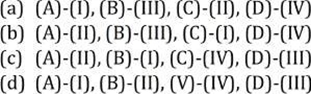
| Q5.Match List -1.—– with List- ll. |
| List – I | List- Il | ||
| (A) | Modal | (i) | to be eliminated completely |
| (B) | Adjective | (ii) | should be eliminated |
| (C) | Adverb | (iii) | sugary, caffeinated drinks |
| (D) | Passive voice | (IV) | electronics to be turned off |
Choose the correct answer from the options given below
Direction for Q6. to QIO. Read the following passage and answer the question that follows:
Conducting an interview should be like painting by numbers ifyou are properly prepared. Consider the various aspects of the interview that benefit from early preparation. Some of these may seem obvious, but if left until the candidates are at the door, they can have a negative effect on the process. A checklist will help to make sure everything is planned and some ofthe less obvious considerations remembered.
Frequently overlooked is the choice of venue and its layout; this can affect the atmosphere of the interview and how candidates respond. The room can feel forbidding, formal, relaxed or cosy, depending on how the furniture is arranged and how the interviewers behave towards the candidates.
Interviewing can be stressful for candidates and interviewers alike, so take account of this in the timing of the  interviews and briefing of the interviewers. Stress levels also influence how interviewers behave towards the candidates; developing skills in how to question and supply information to candidates will smooth the flow and help interviewers
  improve their performance. Of course, question technique, active listening and observation skills benefit managers in other areas of their work, too. The way in which the interview is ended also has an effect on the candidates and may well effect whether the desired candidate decides whether to accept the offer of employment or reject it.
Q6. Who is the intended audience of the passage?
(a). Job applicants
(b). Students
(c). Teachers
(d). Interviewers
Q7. According to the passage, which ofthe following DOES NOT help in reducing stress during an interview?
(a). The behaviour of the interviewer
(b). Timing of the interview
(c). The ability of the interviewer to intimidate the candidate
(d). The ability of the interviewer to convey information to the candidate
Q8. Choose a word from the passage that is closest in meaning to the following word “Unwelcome”
(a) formal
(b). frequently
(c). forbidding
(d). venue
Q9. According to the passage which of the following details is often overlooked while conducting interview?
(a). Age ofthe candidate
(b). Candidate’s attire
(c). Choice of venue
(d). Dietary preference of the candidate
QIO. Which ofthe following could be a suitable title for the passage?
(a). How to conduct an Interview
(b). How to give an Interview
(c).An Introduction to Interviews
(d). How to getaJob
Direction for QII. to Q15. Read the following passage and answer the question that follows:
Learning the Queen’s English is like scrubbing off the bright red varnish from your toe nails, the morning after a dance. It takes a long time and there is always a little bit left at the end, a stain of red along the growing edges to remind you of the good time you had. So, you can see that learning came slowly to me. On the other hand, I had plenty oftime. I learned your language in an immigration detention centre, in Essex, in the southeastern part of the United Kingdom. Two years, they locked me in there. Time was all I had.
But why did I go to all the trouble? Itis because ofwhat some of the older girls explained to me: to survive, you must look good or talk even better. The plain ones and the silent ones, it seems their paperwork in never in order. You say, they get repatriated. We say, sent home early.
The Other Hand is the story of a young woman who flees conflict in her home village in the oil-rich region of southern Nigeria. She makes her way to the UK as an illegal immigrant and is detained for a long period of time at an immigrant detention centre near London. When she finally gets out, she seeks out the only two people she knows in England, whom she met on a Nigerian beach during a life-changing event a few years before. Will she be able to find them, and if so will they help her? And if not, will she survive in her newly adopted country as an immigrant?
Q11. What is meant by ‘Queen’s English’ in the text given:
(A). Good, formal English
(B). Fluent, vernacular English
(C). English as spoken in the UK
(D). Good formal American English
Choose the correct answer from the options given below:
(a). (A), (B) and (C) only
(b). (A), (B) and (D) only
(c). (A) and (B) only
(d). (A) and (C) only
Q12. ‘The Other Hand’ is the story ofNigerian woman who:
(A). lived in a village in Southern Nigeria
(B). was detained in Southern Nigeria
(C). learnt English While in detention
(D). was an illegal immigrant in the UK
Choose the correct answer from the options given below:
(a). (A), (B) and (C) only
(b). (A), (C) and (D) only
(c). (B) and (C) only
(d). (A), (B) and (D) only
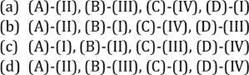
Q13. Match List -1 with List- ii.
| List -I | List – 11 | ||
| (A) | oil rich region | (I) | to survive in the UK |
| (B) | immigration detention centre | (II) | Southern Nigeria |
| (C) | speaking good Enlish | (III) | Southeastern art of the UK |
| (D) | inability to speak ood Enlish | (IV) | to get repatriated |
Choose the correct answer from the options given below:
Q14. Learning Queen’s English is described using a metaphor which is:
(a) to learn to survive
(b). a stain ofred along the greasing edges
(c). scrubbing off the bright red varnish from your toenails
(d). learning comes slowly
Q15. What does the author suggest, would have happened if she hadn’t learnt the Queen’s English?
(a) She would have survived in England.
(b). She would have been repatriated.
(c). She would have stayed longer is detention.
(d). She couldn’t have gone back home easily.
Q16. Choose the correct question tag for the following sentence:
You are a real piece of work,  .
.
(a) aren’t you?
(b). isn’t you?
(c). weren’t you?
(d) are you?
Q17. Chose the correct question tag?
(a). He said that, didn’t he?
(b). He said that, did he?
(c). She didn’tdo that, didn’t she?
(d) They will come, will they?
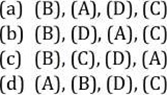
Q18. Rearrange the following segments to make a meaningful sentence:
(A) at the progress India has made in the field of nuclear research
(B). the prime minister looked back with satisfaction
(C). will have to accept India as a nuclear power
(D). and asserted that sooner or later the big powers
Choose the correct answer from the options given below:
Q19. Choose the part of the following sentence that contains an error:
Ranjeeta does not usually prefer staying at cottages, but last winter she spent few days in one.
(a) Ranjeeta does not usually
(b). prefer staying at cottages
(c). But last winters
(d). She spent few days into one
Q20. Rearrange the following parts of a sentence to make a meaningful sentence:
(A) can lead to
(B). a moment offun
(C). life long scar
(D). and merrimen
Choose the correct answer from the options gwen below:
Q21. Choose the part of the following sentence that contains an error: If a company sends its employees abroad to work for a foreign client, they pays them a daily allowance.